
Hearing Crickets? How to Pivot Mid-Launch Without Devaluing Your Offer

You’ve spent months building an offer you believe in with your whole heart. You built the hype, the excitement in your audience is palpable, and you know without a shadow of a doubt that your program is going to produce incredible results for people. You did everything right: you sent the emails, you ran the retargeting ads, you posted organically on social media, and you shared your big vision.
But then the cart opens... and you hear crickets. The enthusiasm just isn't translating into actual investments.
When you find yourself in the middle of a launch week that isn't going according to plan, it is incredibly easy to panic. You might start wondering if your offer is actually good, if you muddied your messaging by going too broad, or if you completely missed the mark with your audience.
In reality, a slow start to a launch doesn't necessarily mean your business is failing or your offer is bad. Often, it just means you are asking overwhelmed consumers to make a high-ticket decision in too short of a window, and you need to pull a few strategic levers to save the launch.
Instead of throwing in the towel or frantically slashing your prices publicly, here is exactly how to pivot mid-launch to get "butts in seats" without devaluing your hard work.
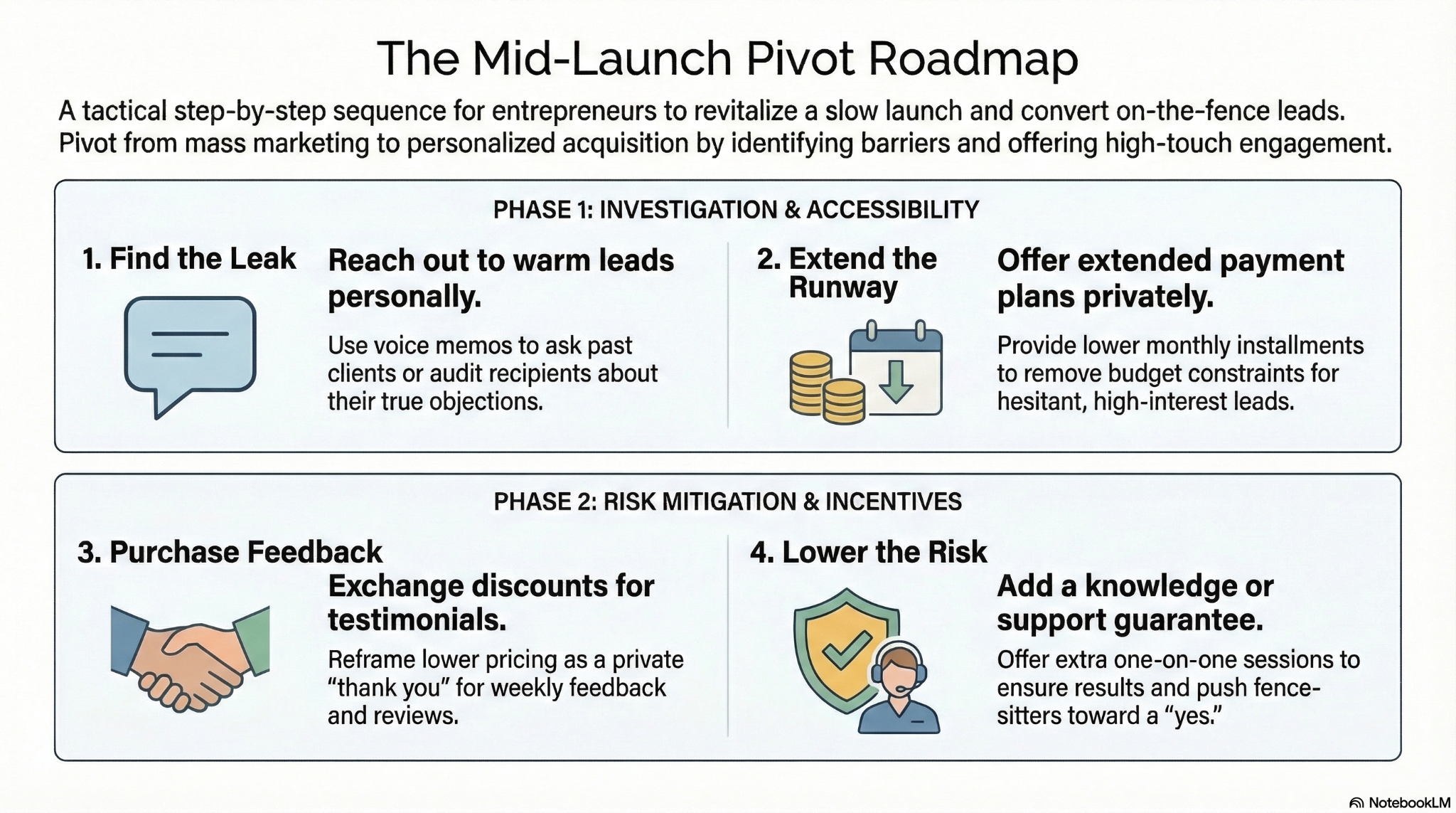
Step 1: Stop Guessing and Find the Leak
When sales are stalling, our first instinct is usually to yell louder, to send another email blast to the whole list, or pump out more short-form videos. But before you change a single thing about your marketing, ask yourself a hard question: do you actually know why people aren't converting, or are you just assuming you know?
You cannot fix a leak if you don't know where the water is pouring out.
- Are your leads struggling to decide if it's the right time for them?
- Do they have budget constraints?
- Are they on the fence because they think they can just figure out the strategy on their own?
To find out, stop broadcasting to the masses and go directly to your warm leads. If you've recently done market research calls, free audits for people on Instagram stories, or if you have past clients who previously expressed interest in this exact topic, reach out to them personally.
And when you do, use your voice. Do not just send a canned, copy-pasted DM. Send a personalized voice memo to check in. Ask them if they had a chance to look at the offer, and if you can chat through any questions they might have. Getting people into a real, one-on-one conversation, and ideally onto a quick 15-minute call within 24 hours, is the absolute best way to uncover the true objections holding them back. You might be surprised to find their hesitation has nothing to do with the value of your offer, and everything to do with a logistical hurdle you can easily fix.
Step 2: Navigate the "Butts in Seats" Beta Dilemma
If you are launching a beta version of your offer or running a cohort for the very first time, your primary goal shouldn't strictly be top-line revenue. You need to look at the bigger picture and ask yourself: What is the actual value of having more people in the room right now?
As creative entrepreneurs, we can get so locked into what we believe our offer is "worth" that we completely miss out on the long-term provision of getting the right people into our ecosystem. If your cart is sitting empty, you aren't going to have anybody inside the program taking behind-the-scenes photos, tagging you in their stories, or building the social proof you desperately need.
For a first round, getting those case studies, gathering detailed weekly feedback, and creating community advocates who will hype you up for your next launch is arguably more valuable than the immediate cash.
If you discover through your voice memos that budget is the primary objection, look for ways to extend your runway. One of the biggest obstacles to conversion is a short launch window where you are asking humans to be instantly ready to pay a large dollar amount. If you don't want to lower your overall price, consider privately offering an extended, longer-term payment plan. Sending a private, "last-ditch effort" option for a lower monthly payment, such as $100 a month for 8 months, can easily convert someone who couldn't swing the upfront cost.
Step 3: Reframe the Discount by "Purchasing Feedback"
Sometimes, you might realize you simply have to drop the price to get those crucial beta testers in the door. But if you have already heavily promoted your price publicly, you don't want to look wishy-washy or desperate by suddenly announcing a massive discount to your entire audience.
The secret to dropping your price without devaluing your brand is simple: you don't do it to the masses.
Instead, reach out one-on-one to three or four specific people who you know would be an absolute perfect fit for the room. When you message them, frame the discount not as a desperate sale, but as a strategic exchange.
Tell them: "I really value your opinion and what you bring to the table. I want more people in this first round so I can get detailed feedback on the curriculum. I'd love to offer you a discount in exchange for your commitment to provide feedback every week and be an advocate for the program".
Alternatively, if you are reaching out to past clients or people you've engaged with deeply, you can frame the private discount as a genuine "thank you" for their past support and interest.
By doing this, you aren't just discounting your hard work; you are literally purchasing their feedback. It is the exact same financial transaction, but the intention behind it shifts the entire dynamic. It removes that "icky" feeling completely because your intention is clear, you see them as a human whose specific insight you value, and you are willing to pay for that knowledge by giving them a break on the price.
Step 4: Introduce a Strategic Guarantee
Finally, if your audience is still on the fence, you need to look at how you can lower the risk for them. Guarantees are incredibly powerful acquisition models, and many people will sign up strictly because a guarantee makes them feel safe.
But if you are a service provider selling something inherently variable, like SEO strategies, design, or copywriting, you might be terrified to offer a guarantee. You know you can't realistically promise a specific financial ROI or a guaranteed number of leads, because the client could ultimately fail to implement the work correctly.
The mindset shift: guarantees exist on a spectrum.
In our own market research, we found that audiences actually measure a 100% money-back guarantee and an "extra support" guarantee fairly similarly. People just want to know they aren't going to be left high and dry if they struggle to get results.
Instead of a financial promise, offer a "knowledge guarantee". Guarantee that if they show up, they will walk away fully understanding the concepts and having a solid structural foundation in place. You must set clear specifications for this to protect yourself: explicitly state that they must watch all the calls, complete the workbooks, and do their part. If they do all of that and still don't understand the strategy by the end of the program, your "guarantee" can simply be that you will give them an additional 30-minute, one-on-one audit to look at their work and fix their leaks.
Just like Costco's famous return policy, offering a safety net encourages people to buy more confidently, even if the vast majority of your clients will never even think of using it.
You Don't Have to Launch Alone
A launch that starts off slow does not mean your offer is a failure. It usually just means your audience needs a slightly different bridge to get to where they want to be. Be willing to pivot, be willing to get on the phone, and be willing to do the unscalable, one-on-one outreach required to build your foundation.
Navigating these real-time business pivots can feel incredibly isolating when you're sitting alone behind your laptop. But you don't have to figure it out by yourself. We workshop these exact strategies, talk through mindset blocks, and hold peer masterminds where you can ask questions every single week inside The Breakroom.
If you are a Creative Entrepreneur who wants to grow your business with a safe, supporting community that won't let you fail alone, we would love to have you.
Come join us in The Breakroom.